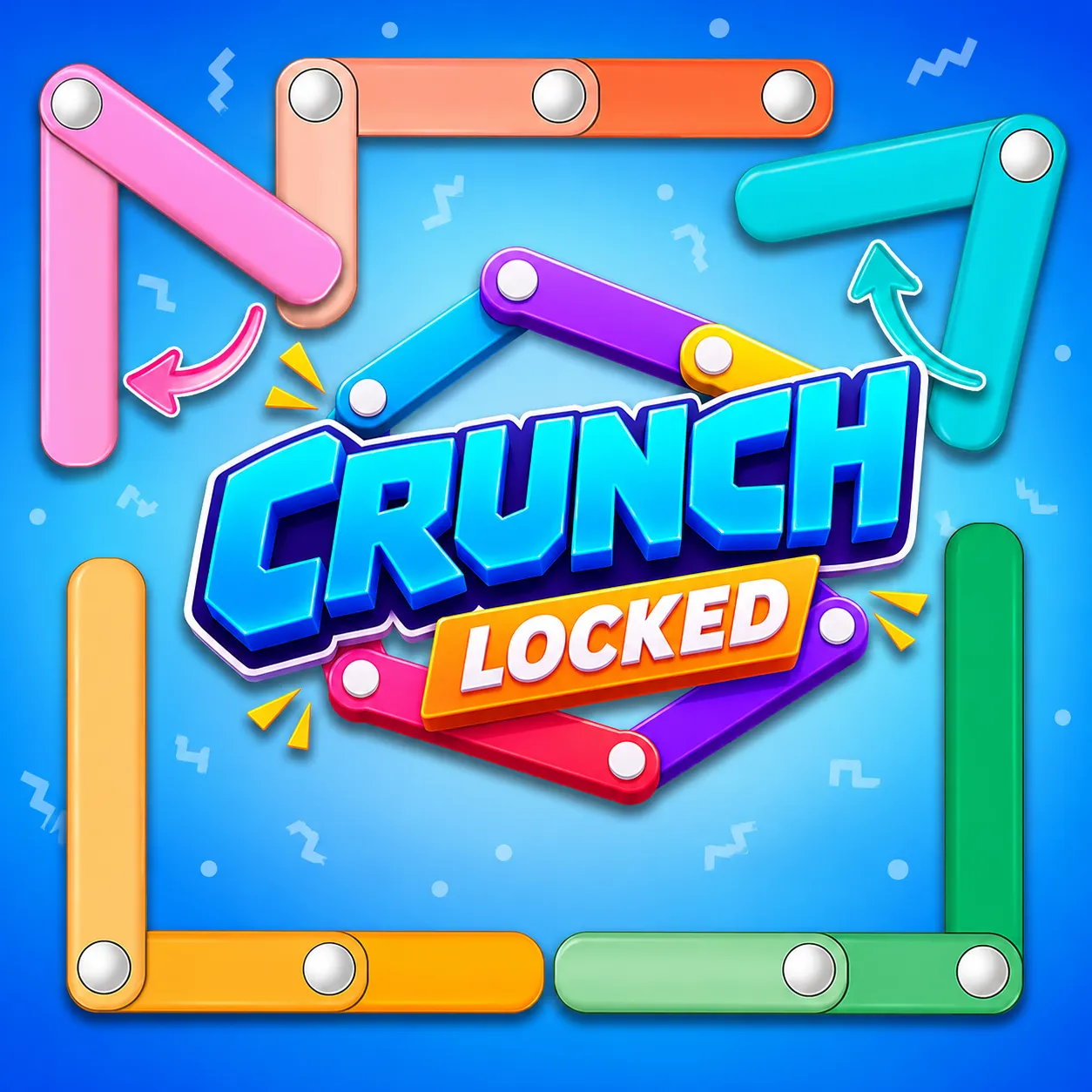
Challenge your logic in Crunch Locked, rotate tangled segments, unlock hidden paths, solve clever folding puzzles, and clear every level today!
ABOUT CRUNCH LOCKED
Crunch Locked is a relaxing yet challenging puzzle game that tests your logic, observation, and planning skills. Each level presents a group of interlocked segments that must be folded away in the correct order until the entire structure disappears.
The controls are simple, but the puzzles become more complex as you progress. Locked pieces, overlapping paths, and tight layouts require careful thinking, making every successful move feel satisfying and rewarding.
MASTER THE FOLDING SEQUENCE
Each puzzle begins with several connected segments arranged in a tangled pattern. Your goal is to fold every movable piece until the structure is completely cleared.
Clicking an available segment rotates it 90 degrees clockwise. However, a segment can only move if another piece is not blocking its path. Some parts are marked as Locked, which means they cannot rotate until nearby obstacles have been removed.
To solve each level, you need to identify which pieces are free, which ones are blocked, and which moves should come first. As the layouts become more difficult, every decision becomes increasingly important.
Understand Locked Pieces
Locked pieces are one of the main challenges in Crunch Locked. They cannot be moved immediately, so trying to rotate them too early will not work.
Instead, focus on the freely movable segments first. Clearing these pieces creates space and may unlock restricted parts later in the puzzle. Paying attention to the position, direction, and layering of each segment will help you discover the correct solution.
Successful players usually study the full puzzle before making their first move. This reduces mistakes and helps avoid unnecessary rotations.
Controls
- Mouse: Left-click a movable segment to rotate it 90 degrees clockwise.
- Mobile: Tap a movable segment to rotate it clockwise.
TIPS FOR SOLVING DIFFICULT LEVELS
When a puzzle seems difficult, avoid clicking randomly. Take a moment to study how the segments overlap and look for pieces that can move without being blocked.
Start with the freely movable segments, then use those moves to open paths for locked or restricted pieces. Try to plan several steps ahead instead of reacting to one move at a time.
Patience and observation are more useful than speed. With the right sequence, even the most tangled puzzle can be folded away smoothly.